
OK, I don't know about you, but I am not a huge sports fan. I danced (ballet and tap) and played volleyball. Organized sports, as a whole, tend to elude my normal orbit. Being in high school, in a town that LOVES it's football, this can be a problem. So today? I have Football FAQs for all of you who are like me AND I have a cool football activity set in my shop now just for you! American football is one of the most popular sports in the United States. If you're new to the sport, it can be a bit confusing to understand all the rules and jargon. But don't worry! This beginner's guide will teach you everything you need to know about football so that you can be an informed fan come game day. The Field Football is played on a rectangular field that is 100 yards long and 53.3 yards wide. At each end of the field there is an end zone that extends 10 yards deep into the field. In the middle of each end zone there is a goal post that consists of two vertical posts connected by a … [Read more...]
The Common Eider: A North American Bird Icon

The Common Eider is a large seabird that can be found in coastal areas of the northern hemisphere. Eiders are easily recognized by their black-and-white plumage and their large, orange bill. These birds are interesting not only for their unique appearance but also for their behavior. For example, did you know that eiders are the only bird species known to use tools? Keep reading to learn more fascinating facts about the Common Eider! Appearance As previously mentioned, Common Eiders are easily recognizable due to their black-and-white plumage. Male eiders have mostly white feathers, while females and juveniles have more dark feathers. Both males and females have a patch of black feathers on their backs, which is where their scientific name, Somateria mollissima, comes from—mollissima means "softest" in Latin. Common Eiders can grow to be quite large, with a length of up to 27 inches and a wingspan of up to 42 inches. Males are typically larger than females, but there is … [Read more...]
The Secret Life of Trees
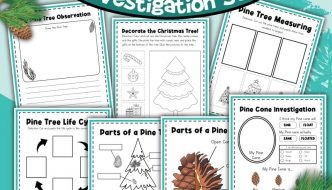
The secret life of trees? Who knew there was even such a thing!?? Plant care is becoming an increasingly important subject, especially now that more Americans are becoming plant parents. In fact, the 2019 National Gardening Survey revealed that American gardeners have spent about $50 billion on lawn and garden retail sales. That number is only growing since the global pandemic hit - families that never even scratched their dirt before were all of a sudden planting gardens and trees to guarantee food for their families. My folks added a pear tree to their mini orchard of an apricot and cherry tree - and wanted an apple tree but there were none available! The Secret Life of Trees Therapist Lily Ewing explained that this trend is also related to our human need to create and nurture connections. Whenever gardeners provide their plants with the right amount of sunlight, water, and nutrients, they're rewarded with growth — from strong roots to lush green leaves. Given how … [Read more...]
Conductors and Insulators: A Lesson on Electricity

Kids learn through play. The best way for kids to learn about electricity is by learning from a teacher or parent and then using that knowledge to perform experiments at home. Whether you are using experiments to supplement a public school education, for homeschool, or to satisfy your child’s curiosity and learn more, there are several experiments that you can perform at home to learn about conductors and insulators. What is Electricity? Electrons are particles with a negative charge. When electrons move from one atom to the next, it creates electricity. Electrons are subatomic particles, which means that they are inside of atoms. A proton is a subatomic particle with a positive charge. Since electrons have a negative charge and protons have a positive charge, they want to match up so they are neutral. Electrons float around the atom until they get enough energy to be pushed towards a proton. When you add electricity, … [Read more...]
Three States of Matter For Kids: Gas, Liquid, and Solid

Do you know what the three states of matter are? If not, this blog post has all the information that you need! The first state is gas. Gases are substances with no definite shape or volume and they can be found in the air. The second state is liquid. Liquids have a definite shape and volume but still, have flowing properties like water or oil. And lastly, there's solid. Solids have a fixed shape and volume like metals or rocks. All about the 3 states of matter lesson plan Matter surrounds you daily, what we touch, and see are all made up of matter. Anything that has mass and takes up space is the general definition of what matter is, and it has to have volume. What is the matter? Matter is made up of atoms that contain protons, neutrons, and electrons. These all come together to form molecules. When the molecules mix with the atoms they form an energetic bond. Mass is measured by the amount of matter inside an object. While it is very similar to weight, the … [Read more...]
The Tree Life Cycle from Seed to Shade
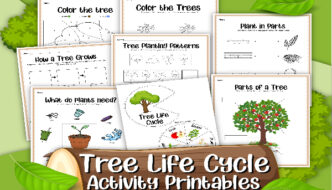
Trees are an important part of the ecosystem. They provide oxygen, shade, and also protect soil from erosion and flooding. Trees can live a long time too - over 200 years! So what is the tree life cycle? Is there one? The answer to this question has many parts. In this blog post we will explore all stages of trees' lives as they grow from seed to becoming a beautiful shade-providing fixture in our environment! The Tree Life Cycle from Seed to Shade Did you know that seeds grow into saplings only to be cut down and turned into paper for your notebook or scrapbook? As the tree matures, it may produce flowers and fruit. The seeds from these fruits are spread by wildlife or humans who enjoy eating them as well! When a mature tree dies, decomposition begins with fungi breaking down the tough woody tissues into simpler compounds that can be used to form new soil. This is how trees take nutrients back up into their roots for future growth! The life cycle of a tree isn't … [Read more...]
- « Previous Page
- 1
- …
- 8
- 9
- 10
- 11
- 12
- …
- 23
- Next Page »

What Visiters Had To Say