
Kids learn through play. The best way for kids to learn about electricity is by learning from a teacher or parent and then using that knowledge to perform experiments at home. Whether you are using experiments to supplement a public school education, for homeschool, or to satisfy your child’s curiosity and learn more, there are several experiments that you can perform at home to learn about conductors and insulators. What is Electricity? Electrons are particles with a negative charge. When electrons move from one atom to the next, it creates electricity. Electrons are subatomic particles, which means that they are inside of atoms. A proton is a subatomic particle with a positive charge. Since electrons have a negative charge and protons have a positive charge, they want to match up so they are neutral. Electrons float around the atom until they get enough energy to be pushed towards a proton. When you add electricity, … [Read more...]
Three States of Matter For Kids: Gas, Liquid, and Solid

Do you know what the three states of matter are? If not, this blog post has all the information that you need! The first state is gas. Gases are substances with no definite shape or volume and they can be found in the air. The second state is liquid. Liquids have a definite shape and volume but still, have flowing properties like water or oil. And lastly, there's solid. Solids have a fixed shape and volume like metals or rocks. All about the 3 states of matter lesson plan Matter surrounds you daily, what we touch, and see are all made up of matter. Anything that has mass and takes up space is the general definition of what matter is, and it has to have volume. What is the matter? Matter is made up of atoms that contain protons, neutrons, and electrons. These all come together to form molecules. When the molecules mix with the atoms they form an energetic bond. Mass is measured by the amount of matter inside an object. While it is very similar to weight, the … [Read more...]
The Tree Life Cycle from Seed to Shade
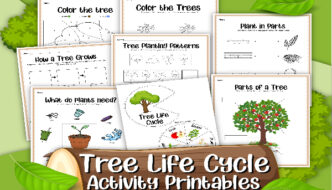
Trees are an important part of the ecosystem. They provide oxygen, shade, and also protect soil from erosion and flooding. Trees can live a long time too - over 200 years! So what is the tree life cycle? Is there one? The answer to this question has many parts. In this blog post we will explore all stages of trees' lives as they grow from seed to becoming a beautiful shade-providing fixture in our environment! The Tree Life Cycle from Seed to Shade Did you know that seeds grow into saplings only to be cut down and turned into paper for your notebook or scrapbook? As the tree matures, it may produce flowers and fruit. The seeds from these fruits are spread by wildlife or humans who enjoy eating them as well! When a mature tree dies, decomposition begins with fungi breaking down the tough woody tissues into simpler compounds that can be used to form new soil. This is how trees take nutrients back up into their roots for future growth! The life cycle of a tree isn't … [Read more...]
All About the Life Cycle of Fungi

The Life Cycle of Fungi? When most people think of fungi, they think it’s just one thing that can grow in different places. However, there are more than 90,000 other fungi species in existence. Although some fungi look like plants, they’re not plants, and there’s a lot about fungi that sets them apart from other living and breathing things on the planet. If you’d like to learn more about fungi, such as how they develop and spread, you’re in the right place. What Is a Fungus? Fungus is an organism classified as a Eukaryote. It has a nuclear membrane and nucleus. It produces spores and is commonly found outdoors, especially on trees and logs in forests and other areas with lots of foliage. While fungus often develops and spreads outdoors, that isn’t the only place where you can find it. It’s not uncommon to find fungus in the home, including on old, spoiled food. Fungi have cells similar to plants and animals, which eliminates them from being classified as … [Read more...]
All About the Gymnosperm Life Cycle

The name gymnosperm comes from a Greek word that means naked seeds. They are so named because the seeds are not enclosed in an ovary and instead are on the surface. Gymnosperms are plants that produce cones and seeds instead of flowers. Pine, spruce, fir, and ginkgos are all examples of gymnosperms. They often grow in temperate and boreal forests in wet or dry climates. Gymnosperms are the Oldest Type of Plant Gymnosperms date back to the Paleozoic era where they were an abundant plant. Today, there are about 700 to 900 living species. They are thought to be the first vascular plants on lade, and they first appeared about 245 million years ago. A plant’s vascular system allows water to move from the root to the rest of the plant. Without it, plants can not survive on land. However, the gymnosperm is thought to be the first vascular plant, and thus the first plant that could survive on land. How … [Read more...]
All About Hummingbirds and the Hummingbird Life Cycle

In this unit study, we will learn about hummingbirds and about their characteristics. Many people attract these small birds to their backyards because they are so unique. Hummingbirds are fun to watch, especially while they eat. People plant specific flowers and place hummingbird feeders in their yards to attract these birds in order to watch them for entertainment. What is a Hummingbird and What Do They Look Like? Hummingbirds are small wild birds. There are more than 300 species of hummingbirds in the world, and there’s a lot of variation between the species. Hummingbirds have a distinct physical appearance. They are so named because they make a humming noise when they fly because their wings move so quickly. Hummingbirds are only found in the Western Hemisphere. They are found as far north as Northern Canada and Alaska and as far south as South America. South America and Central American have more species than North … [Read more...]
- « Previous Page
- 1
- …
- 19
- 20
- 21
- 22
- 23
- …
- 53
- Next Page »

What Visiters Had To Say