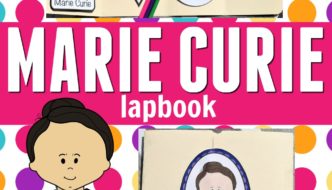
How to Make a Marie Curie Lapbook? If you find yourself researching great female legends of science, you can't possibly leave out Madame Marie Curie! Marie Skłodowska Curie, born Maria Salomea Skłodowska, was a Polish and naturalized-French physicist and chemist who conducted pioneering research on radioactivity. How to Make a Marie Curie Lapbook Marie was born in 1867, and lived until she died from radiation poisoning in 1934. While a tragic end, her contributions to science are legendary and puts her on the map to learn more about. We don't need to go in depth about her death, but to highlight her discoveries, and all that we learned from her life experience. When trying to teach the littles about her - the best way to do it is debatable. My mom always used learning posters, but the updated version of that is the concept of a homeschool Lapbook. What you need for the Marie Curie Lapbook project A manilla file folder, scissors, glue, and your choice of … [Read more...]
Know The Red Planet Printable
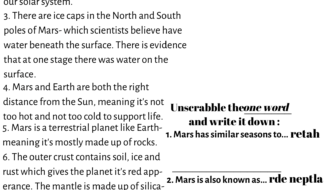
The Red Planet is our closest neighbor and a fun way to start getting your budding scientist into planetary exploration as it can be seen from the night sky with the naked eye. All about the red planet Mars is sometimes called the Red Planet. It's red because of rusty iron in the ground. Like Earth, Mars has seasons, polar ice caps, volcanoes, canyons, and weather. It has a very thin atmosphere made of carbon dioxide, nitrogen, and argon. Why was the red planet named after the god of war? According to Universe Today, is named after the Roman god of war. Many believe that ancient peoples associated Mars with bloodshed and war because of its red color. The Romans were not the only society to associate the planet with bloodshed. The ancient Babylonians called it Nergal, after their god of fire, war, and destruction. See it in our store HERE: Know Your Planet Mars, Mars, Planets, Digital Download, Printable Download, Instant Download, STEM, STEM Activities, Planet Mars … [Read more...]
FREE Scientists Color and Letter Tracing Book
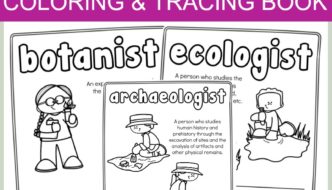
Do you have a little scientist or scientist want-to-be? This might be the perfect free color and letter tracing book for you! WIth eighteen pages of fun, you can explore the world of different knids of scinetist as you build manula dexterity skills and work on basic printing. Letter Tracing Book? I am living proof that kinds can learn to read and write much sooner than most people think of as normal. Add in the fact that my folks never "dumbed down" conversation with m e and you have a winning formula for getting your little scholar excited about the world of science. What is a Scientist? According to Wikipedia: A scientist is someone who conducts scientific research to advance knowledge in an area of interest. In classical antiquity, there was no real ancient analog of a modern scientist. Instead, philosophers engaged in the philosophical study of nature called natural philosophy, a precursor of natural science. What you can expect from this letter tracing … [Read more...]
FREE Cow Life Cycle Learning Poster

I just got a puppy - and named her Tazuna. She is an Australian Shepard and beyond adorable (picture at the end of this article). Tazuna is a Japanese name that comes from one of m college courses this semester - I am taking Japanese 103 - the first college year of the Japanese language. Well - totally rambling, but the breeder we got her from lives on a farm and they have a ton of cows. It got me thinking about a Cow Life Cycle activity that I could share with you. Why a Cow Life Cycle Learning Poster? I have told you before how my mom did a lot with learning posters when I was smaller, so this lapboard - or learning poster seemed like a perfect idea! You can engage the kiddos with coloring, cutting, and gluing all items - have no fear, all the directions are in the PDF file for you! Cows are pretty cool animals, actually - they are devoted mothers and are known to walk for miles to find their calves. Cows have an excellent sense of smell. They can detect odors up to five … [Read more...]
Know Your Planet Jupiter Quick Unit Study
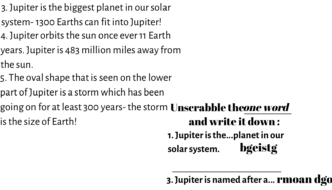
The planet Jupiter is a gas giant, and it lacks a true surface. It is made up of about 90% hydrogen and 10% helium. Jupiter has a faint ring system, and it is second in terms of the number of satellites only to Saturn. It has 79 moons, four of them, the Galilean moons, helped shape our view of the Universe. Know Your Planet Jupiter If that isn't enough to excite your budding astronomer to learn more about it, I don't know what is. That is why I have my Know Your Planet Jupiter today - as part of my series on our solar system. Get your free printable worksheet here: Other fun posts for your young astronomer: … [Read more...]
Know Your Planet Venus
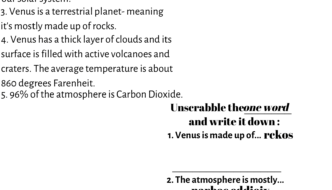
My love of all things astronomy are what got me into college early. I really wanted to take Astronomy 100 at the University of Wisconsin but there were prerequisites that I had to do first so I would have to wait. I ended up taking Meteorology first. Still, I ended up taking it through Arizona State University and aced it - ha! No prerequisites were needed and I learned about the planet Venus, and more. Know Your Planet Venus Venus's orbit around the sun is the 2nd fastest orbit of all the solar system planets. Venus is the slowest rotating planet and rotates backward. Venus is the hottest planet in the solar system and can reach an amazing 900 degrees. Venus orbits the sun in 225 days, which means 1 Earth year on Venus is 225 days. And that is just some of the simple facts. This worksheet is for the budding young astronomer and one of a series. Have fun with it! You can print this worksheet off yourself right here: Other things a budding young astronomer might … [Read more...]
- « Previous Page
- 1
- …
- 13
- 14
- 15
- 16
- 17
- …
- 21
- Next Page »

What Visiters Had To Say