
Understanding and mastering integers are crucial for your progress in mathematics, particularly as you venture into 7th grade where the complexity of math problems increases. Integer games for 7th graders provide an engaging and effective way for you to master this fundamental concept. Through interactive play, these games help consolidate your mathematical understanding while keeping the process fun and stimulating. The array of games available can help you grasp everything from basic operations to more advanced integer concepts. For instance, you can reinforce your skills in adding and subtracting by participating in various online match: add and subtract integers games. Here, the pairing of visual feedback with immediate practice aids in cementing the rules and processes involved in handling integers. Moreover, games that incorporate a competitive element, like Integer War, allow you to challenge yourself and others. This particular card game translates the abstract ideas of … [Read more...]
Financial Literacy Games for College Students: Enhancing Money Skills Through Play

Understanding financial concepts is crucial for managing personal finances, especially for college students preparing for real-world financial responsibilities. Financial literacy games present an engaging way to gain valuable financial skills and knowledge. These interactive experiences simplify complex financial topics, allowing you to learn about budgeting, saving, investing, and credit in a relatable and enjoyable manner. Incorporating gamification in financial education helps to reinforce learning and improve the retention of financial concepts. By participating in these games, you can explore various financial scenarios in a risk-free environment. This hands-on approach empowers you to make informed financial decisions and develop healthy money management habits that can benefit you throughout your life. Whether you're dealing with student loans, planning for future expenses, or just trying to navigate day-to-day budgeting, these educational games can transform the … [Read more...]
Factoring Trinomials: A Step-by-Step Guide for Efficient Problem Solving

Factoring trinomials is a fundamental skill in algebra that allows you to simplify expressions and solve quadratic equations. A trinomial is a polynomial with three terms, typically written in the form ax^2 + bx + c. The process of factoring involves breaking down this expression into a product of binomials. To factor trinomials effectively, you need to recognize patterns, apply specific techniques, and often, a bit of trial and error is involved to determine the factors that multiply to give the original trinomial. Understanding how to factor trinomials is crucial because it not only aids in equation solving but also in simplifying algebraic expressions. Whether the leading coefficient is one or another number, the principles of finding two numbers that both add to give the middle coefficient, b, and multiply to give the product of the leading coefficient, a, and the constant term, c, are central to the process. With practice, you'll become more adept at factoring trinomials, … [Read more...]
Math Logic Questions: Sharpen Your Analytical Skills with Puzzles
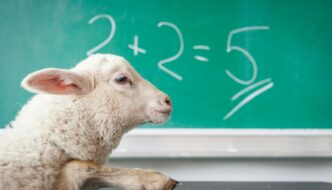
Math logic questions are a stimulating way to test your reasoning skills and problem-solving abilities. They require a blend of numerical understanding and the capacity to think critically, often presenting problems in a way that transcends straightforward calculation. Whether you're a math enthusiast or someone looking to sharpen your cognitive abilities, engaging with these puzzles can be both challenging and rewarding. Exploring various types of math logic questions, you'll encounter scenarios that necessitate deductive reasoning, pattern recognition, and sometimes a bit of creativity to navigate to an answer. They often come in the form of riddles, number games, or visual puzzles, each designed to push the boundaries of your logical thinking. From the simple satisfaction of solving a tricky problem to the mental exercise it provides, delving into math logic questions can be immensely beneficial for learners of all ages. These puzzles aren't just academic exercises; they … [Read more...]
🎉 3.14 ways to celebrate Pi day 🎉

Happy Pi day, everyone! In honor of this special day, we wanted to share with you some fun and creative ways to celebrate pi day. Whether you're a math enthusiast or just enjoy delicious pie, there's something for everyone on this list! So without further ado, here are 3.14 ways to have a blast on Pi day! What is Pi? Pi (π) is a mathematical constant that is the ratio of a circle's circumference to its diameter. It is approximately equal to 22/ seven, or roughly three point one four. Pi has been calculated to be over one trillion digits past its decimal point and continues infinitely without repetition or pattern. Who created pi? The first calculation of π was done by Archimedes of Syracuse (287–212 BC), one of the greatest mathematicians of the ancient world. If you homeschool, this would be an incredible subject for a report! But whyis Pi so important? We can’t think about the advancement of science and technology without considering pi. It has been used every day … [Read more...]
Missing Numbers for First Graders

Missing Numbers? This is a classic skill that they are working on for both kindergarten and first-grade math classes. As you build to first-grade skills, you should be able to count from 1 to 100. Missing Numbers for First Graders This worksheet covers a few different concepts – first of all, working in a sequence. There is only ONE number of each set of ten in a row. You little student has to fill in 90 blanks out of 100, What are Missing Numbers? Missing numbers are the numbers that got missed in the given series of numbers with similar differences among them. The process of writing the missing numbers is termed as finding similar changes between those numbers and filling their missing values in their specific series and places. This activity is a great way to introduce number order! You can show them how row two all start with a “1”, how row three all start with a “2”, etc – to cover the teens, twenties, etc. You can teach multiplication too! Let’s start … [Read more...]

What Visiters Had To Say